
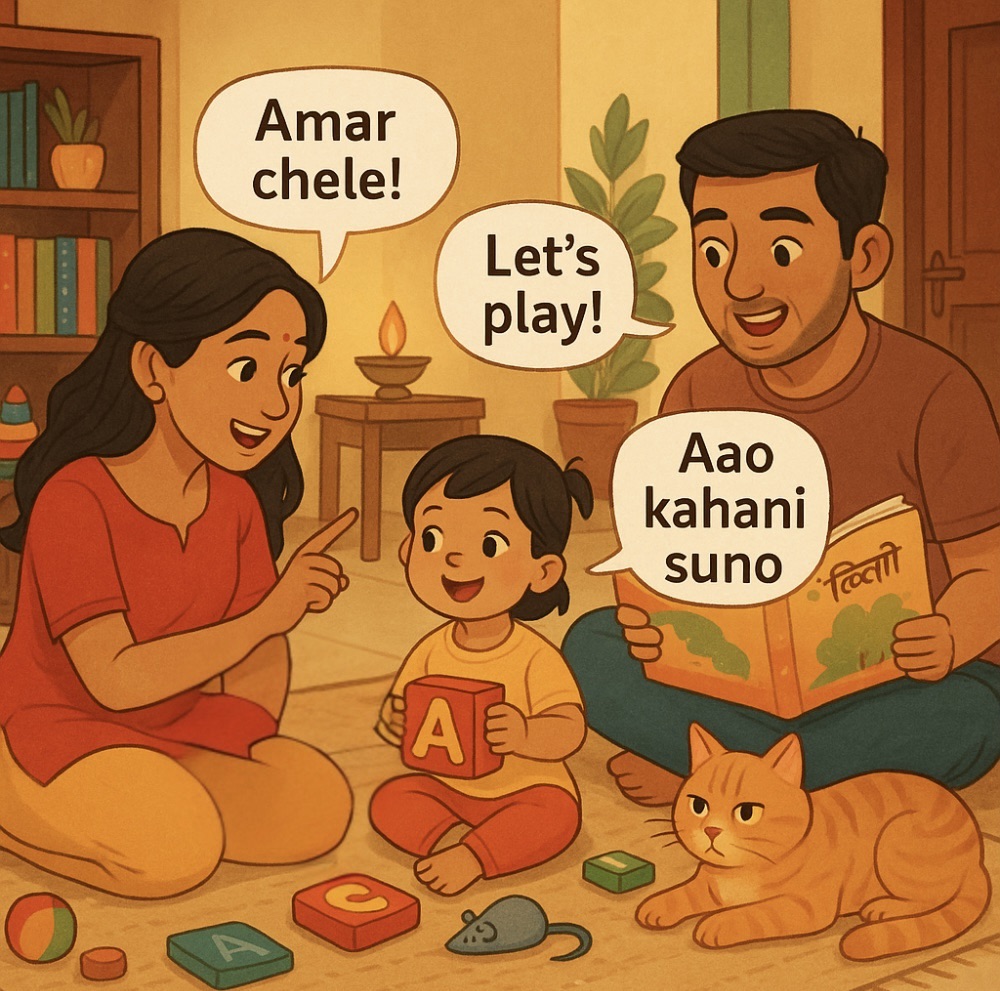
(A Fun Guide for Families Who Juggle More Languages Than Shoes!)
So, here’s the situation:
I’m Bengali, my husband is from the Hindi-speaking belt (and, for some mysterious reason, has zero grasp of “Ei je!”, “Ki korcho?”, or anything else that sounds remotely Bengali), and we live in Tamil Nadu, where the local “Vanakkam” reigns supreme. Oh, and did I mention we speak English most of the time—both at home and out in the big, wide world?
It’s like a linguistic circus in our household, and we’re determined that our kid (or future kids) will speak all the languages we’re tossing in the air.
If you’re in a similar pickle—congratulations, you’re raising a multilingual child in India!
Here are some fun tips to help you navigate this comedic yet rewarding journey.
1. Embrace the Language Mash-Up
In India, it’s totally normal to jump from “Kemon acho?” to “Kya haal hai?” to “Enna pannreenga?” and wrap it up with “I’m hungry, let’s order idli!” in the span of five minutes.
If you do this at home, own it.
- Language Soup: Your child might mix up words at first—like saying “Ami hungry hoon.” (That’s 50% Bengali, 50% Hindi, 100% adorable.) It’s okay! They’ll sort it out eventually.
- Fun Fact: Kids pick up context clues faster than you think. They’ll learn who to speak which language with, and in no time, they’ll be scolding you for your poor pronunciation (just wait).
2. Pick a “Language Plan”
(Or Wing It… But Better to Have a Plan!)
When you have multiple languages swirling around, a tiny bit of structure can help.
- One Parent, One Language (OPOL):
- You speak to the child exclusively in Bengali, your husband in Hindi(assuming he’s up for it!), and the environment (school, TV, friends) covers English and Tamil.
- Bonus side effect: Your husband might finally pick up some Bengali if he’s eavesdropping on you teaching the baby.
- Minority Language at Home:
- If you want your child to really nail Bengali or Hindi, try making it the main language at home while letting English/Tamil dominate outside.
- Downside: Expect your child to occasionally look at you like you’re an alien if they hear English from you in public and Bengali at home.
Honestly, any plan is better than no plan—but don’t sweat it too much.
The key is consistent exposure in each language.
3. Make Language Fun!
Because if learning isn’t fun, kids turn into mini protestors with “No more alphabets!” banners.
- Story Time: Read bilingual or multilingual storybooks. Bonus if they have big, colorful pictures (keeps your child interested, and maybe your husband too).
- Songs & Rhymes: Children’s songs in Bengali, Hindi, Tamil, and English are gold. They’re catchy, and kids absorb them like sponges. Just be prepared to have “Humpty Dumpty” in your head at 3 a.m.
- Cartoons: Let them watch short, age-appropriate cartoons in each language. Yes, screen time can be educational if you keep it balanced.
4. Involve the Extended Family
(A.K.A. Free Language Tutors!)
One of the biggest perks of living in India is extended family. They’re usually more than happy to video call and speak to your child in their mother tongue.
- Grandparents & Aunts/Uncles can be the best teachers of tradition, culture, and those random proverbs you never learned.
- Encourage them to stick to their language with the child. Consistency is key!
5. Use Your Environment
Living in Tamil Nadu means your child is naturally exposed to Tamil.
Don’t shy away from it—embrace it!
- Local Interactions: Trips to the market, playing with neighborhood kids, or even greeting the watchman—let your child pick up everyday Tamil phrases.
- Label Things at Home: If you’re feeling extra, label objects (chair, table, fridge) in different languages. It might look weird to guests, but hey, you’re raising a polyglot here!
6. Expect Language Mix-Ups & Smile Through Them
Your child might invent sentences like “Ami want pani” or “I want doodh, please.” That’s part of the process.
They’re not “failing”—they’re exploring.
- Gently Correct: If they say something like “Ami want pani,” you could respond with “Oh, you want water? Okay, here’s your water!” That way, they hear the correct word in context.
- No Shaming: Kids pick up on stress. If they sense you’re upset or impatient, they might shut down.
7. Patience, Patience, Patience
Remember, raising a multilingual child is a long game.
Some days, you’ll hear your child confidently say “Ami bhalo achi!” (I’m good in Bengali) and you’ll feel like a proud linguist.
Other days, they’ll stare blankly when a grandparent says something in Hindi, and you’ll wonder if they’ve learned anything at all.
They have.
It just takes time.
8. Celebrate Milestones
(No Matter How Small)
- The first time they say “Dada” in Bengali or “Aap Kaisa Ho?” in Hindi is worth cheering for.
- Let them show off to relatives, neighbors, random passersby in the street. They’ll get a confidence boost, and you’ll get bragging rights.
Final Thoughts
Raising a multilingual child in India can feel like you’re living in a Bollywood-Kollywood-Tollywood crossover—but it’s also an incredible gift.
You’re giving your child multiple lensesthrough which to see the world, connect with family, and embrace the rich tapestry of Indian culture(s).
So keep speaking your mother tongue, let your partner keep trying to speak his (or at least understand yours!), and let Tamil and English flow in naturally.
In a few years, your child might be the one teaching you new words in all four languages.
Until then, enjoy the language rollercoaster…
Because you’re doing an awesome job, Mama!









Leave a comment