
Published on The Good Juju
By a mom raising babies, cultures, and nostalgia—one Rabindra Sangeet at a time
⸻
Every Pochishe Boishakh, something almost sacred (and usually slightly off-tune) unfolds in Bengali homes—whether you’re in Kolkata, Coimbatore, or somewhere in between with sambhar in the fridge and shorshe on the mind.
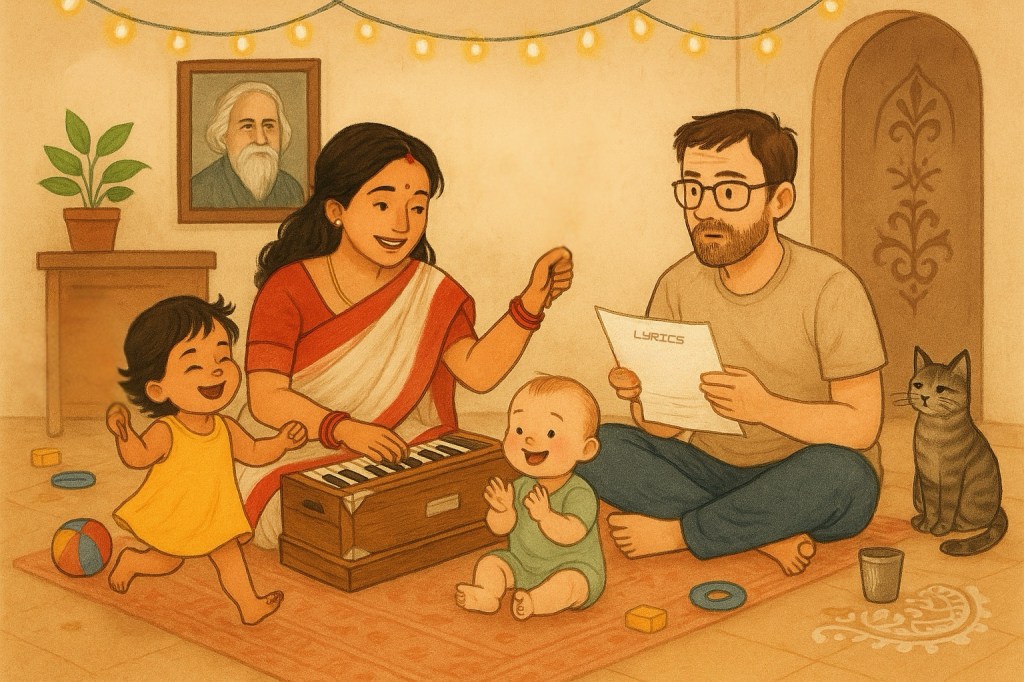
We dust off the harmonium like it’s a holy relic, wrap ourselves in nostalgia and possibly a red-bordered saree if the baby hasn’t drooled on it, and surrender to an evening of Rabindra Sangeet.
Pitch-perfect or not, every note carries memory, meaning, and maa’s gentle humming in the background.
Why all the drama?
Because this is the birthday of Rabindranath Tagore—or as we lovingly call him, Gurudev.
Born on Pochishe Boishakh, 1268 (aka 7 May 1861) in Jorasanko Thakur Bari, Kolkata, he wasn’t just a poet.
He was the poet, the artist, the philosopher, the educationist, and probably the kind of child every Bengali parent daydreams of when their toddler finally stops throwing peas.
Tagore gave us more than just Gitanjali or Ekla Cholo Re.
He gave us:
- India and Bangladesh’s national anthems (excuse me, the range?)
- A Nobel Prize in 1913 for Gitanjali—the first ever awarded to a non-European in Literature
- And a vision of education that became Santiniketan and later, Visva-Bharati University, where minds and melodies wandered free under open skies.
Read more about Tagore on the Nobel Prize website
⸻
My family’s Santiniketan connection runs deep.
My grandfather studied at Visva-Bharati, in its golden age of stillness and soul.
He was there the day Tagore passed—he always described the campus as falling under a spell.
“No one spoke. No one ate. Even the birds were quiet,” he’d say.
It wasn’t the end of a man.
It was the end of an era.
He also told us about how freedom fighters once took refuge in the campus.
The British police weren’t allowed to enter, honoring the sacredness of Tagore’s institution. The freedom fighters stepped out on their own, heads high.
Even colonial rule paused for Gurudev.
Goosebumps? Every single time.
⸻
Now, years and generations later
Here we are.
Our household doesn’t run on just Bengali anymore.
It runs on a curious blend of English, Hindi, Tamil, baby babble, and occasional meows from Bobi the cat.
But on Pochishe Boishakh? Bengali takes the stage.
Out comes the harmonium, wheezing in sympathy with me post-laundry.
My non-Bengali husband squints at Romanized lyrics of Tumi Robe Nirobe, looking mildly terrified.
My toddler thinks Ekla Cholo Re is a marching anthem and insists on doing laps across the living room.
The baby claps for everything. Even tuning.
10/10 for enthusiasm.
It’s messy.
It’s out of sync.
And it’s breathtakingly beautiful.
Because keeping culture alive isn’t about perfect renditions.
It’s about showing our kids that somewhere in our bones is a poet who taught us how to dream.
Who told us that art is rebellion,
that love can be melody,
and that freedom can bloom in open-air classrooms.
⸻
So this Pochishe Boishakh, sing loud.
Even if you’re out of tune.
Even if your toddler thinks it’s a parade.
Because Tagore wouldn’t care about your pitch,
as long as your heart was in the song.
⸻
More…
Want to read more about Tagore’s timeless legacy?
Start here:
Just a heads-up: This post contains affiliate links. That means if you click and make a purchase, I might earn a tiny commission—at no extra cost to you! For all the fine print, check out my affiliate disclosure.
Subscribe now and Stay tuned for more stories from “The Good Juju”—where motherhood, memory, and a little mischief always find their rhythm.










Leave a comment