There’s something about Poila Boishakh that smells like new clothes, mango blossoms, and freshly printed Bengali calendars with dates marked in red for pujos and holidays. Growing up in Bengal, this day was basically our version of spring cleaning meets musical open mic meets “let’s pretend we like summers.”
And let’s not forget the national anthem of the day:
Esho He Boishakh…
If you were even slightly trained in Rabindrasangeet (which, if you were a little girl in Bengal, you most definitely were), you’d have your one go-to song locked and loaded. And you’d sing it at every gathering, with dramatic hand gestures, eyes closed for the high notes, and at least one enthusiastic aunty wiping a nostalgic tear. If your mom was extra invested, you’d be singing the second verse too, even if your voice cracked at “someerono bondhono haara…”
Oh, and if you’re wondering where to find the lyrics to Esho He Boishakh (because obviously you forgot the second verse after all these years), don’t panic. Here is the link to access the one and only Geetobitan, the holy grail of Rabindra Sangeet. Because let’s be honest—without this, the entire month of Boishakh (and the very purpose of our existence as Bengalis) is basically cancelled.
Childhood, where the biggest worry was whether your new Poila Boishakh outfit was more stylish than your cousin’s, and if you’d be allowed second helpings of mishti. Spoiler alert: you wouldn’t. But the shondesh would taste better when stolen anyway.
New Year, New Threads
Poila Boishakh was never just about dates changing. It was a full-on seasonal reset. Parents bought new cottony, breathable, summer–friendly outfits not just for us kids but for cousins, uncles, maashis, and often even the kind neighbour who lent her sewing machine in winter.
I didn’t realize it back then, but this ritual of giving new clothes wasn’t just for the aesthetics or Instagram (because that didn’t exist, thank you very much). It was deeply symbolic. A literal shedding of the old.
As Tagore said,
Jirno ja-kichhu jaaha-kichhu kheen
Nobiner maajhe hok ta bilin –
Dhuye jaak jato purano molin
Nabo-aaloker snaane.
Let the worn and weary fade, and let us welcome the new with open arms (and preferably with rayon, because cotton wrinkles).
Sweet Beginnings
And of course, there were sweets. Mishti doi, rosogolla, narkel naru—all sending out a very clear memo: “Let the coming year be as sweet as this.” No matter how chaotic things got, the sugar rush was non-negotiable.
Probashi but Poila-Proud
Fast forward 15 years and many, many kilometers. From Bengal to the United States to now, Chennai—where seasons go like: hot, hotter, hottest, and surprise cyclonic depression—I’m still clinging to my Poila Boishakh roots like a well-worn gamcha.
Even in the US, through six years of confusing spring weather and last-minute snow flurries, I made sure I had a summery new dress ready. Didn’t matter if it was sleeveless and I had to wear it with a winter coat. Poila Boishakh demands new clothes, and so help me, I delivered.
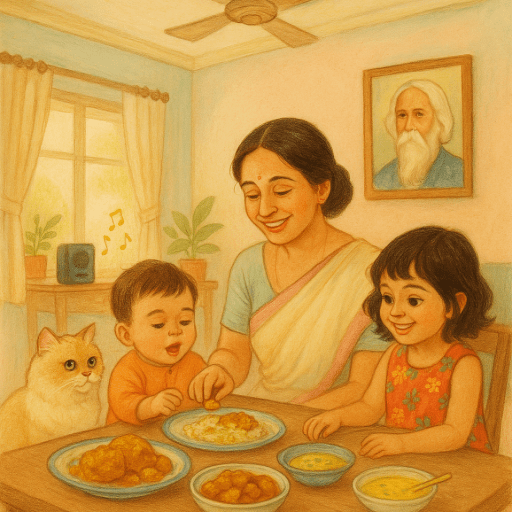
Now, in Chennai, where the concept of seasons is mostly theoretical, I still dress up. My kids, too, get their Poila outfits—light cottons, bright colors, and matching smiles (bribed with mangoes, of course). The idea is simple: start the year with sweetness, sunshine, and something new.
Food, Glorious Bong Food
My tastebuds are loyal to tradition, even if the calendar app forgets Poila Boishakh. I whip up Pulao, Dhokar Dalna, and Kacha Aam-er Chutney. The house smells like home—even if Bobi the cat eyes the pulao like he was deprived of his ancestral rights.
If you want to recreate this at your own table, here’s what I make every year:
(Thank you Bong Eats, for being the most reliable virtual mashima ever.)
Passing the Torch
Traditions change. We move, adapt, improvise. But some things stick—like Tagore songs on April mornings, the feel of crisp new clothes, and the scent of cardamom and ghee wafting from the kitchen.
This Poila Boishakh, wherever you are—whether you’re in Kolkata or California or sweating it out in Chennai like me—I hope you celebrate it your way. With a little song, a little sweetness, and a whole lot of good juju.
Shubho Noboborsho!









Leave a comment